


Rice cultivation and types of nutritious grains
white rice
This rice is made by scraping off the entire outer layer of brown rice, leaving only the starchy endosperm.
It's soft and allows you to enjoy the natural sweetness of the rice.
It has the same energy and protein content as other rice, but the nutritional value of dietary fiber, vitamins, and minerals has been lost.
brown rice
Brown rice is rice that has been threshed from the husk before it is polished. You can get all the nutrients from rice (dietary fiber, vitamin E, vitamin B1, etc.), but because it is rich in dietary fiber, it has a crumbly, crunchy texture.
You also need to use cooking methods that are specifically for brown rice.
The photo on the right is an enlarged view of brown rice.
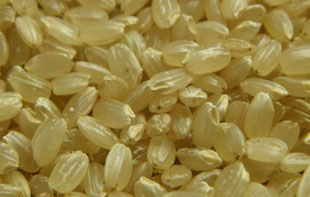
The brown part in the photo is brown rice, and the surface is the bran layer.
The white dot at the tip is the germ, and this is where the sprout will emerge. This is where a lot of nutrients are packed.
From the time of export to Japan until the day of delivery, Inazoumai is stored in this brown rice state at a cool temperature to slow deterioration.
Polished rice with germ
Inazou Rice Store recommends " germ polished rice ." The fiber (bran layer) that makes brown rice lumpy is removed by about half, making it much easier to eat. It also contains 4 to 8 times more vitamin E and B1 than white rice.
Inazo Rice Store 's germ rice is polished to nearly 7 minutes, making it much easier to eat.
It can be cooked in the same way as white rice and is delicious.
Black rice morning purple
It is made from glutinous brown rice, but it is soft and easy to eat.
The main component of the black color is the antioxidant polyphenol, which dissolves when cooked, turning the rice purple.
We recommend mixing about one tablespoon of this powder with one cup of white rice or germ-polished rice while cooking.
Since this is brown rice, it is recommended to soak it in water only for the amount you will be cooking.
Glutinous barley (Kusumochi Nijo)
New in 2019, this is a new variety of sticky wheat with a vibrant light yellow color.
10g of 100g contains dietary fiber. Of this, 6.7g is beta-glucan, which activates immune cells. Brown rice contains insoluble dietary fiber, which absorbs water, expands, and cleanses the intestines. This is mainly insoluble dietary fiber, which serves as food for good bacteria.
It has neither the distinctive smell nor the distinctive taste of barley that is common in pressed barley or nine varieties of glutinous barley.It has a clear taste that does not interfere with the flavor of rice and allows you to fully enjoy the texture.
Germinated brown rice
Brown rice usually requires rinsing in a metal colander and soaking for a long time to soften.
Germinated brown rice contains nearly five times the amount of GABA found in brown rice, and is gelatinized (turned into starch) using high-temperature steam and high-frequency waves, and then dried to make it easier to eat.
GABA is an inhibitory neurotransmitter that works in the brain, so if you're feeling less calm than usual, you may be lacking this nutrient.
You can mix it with white rice and enjoy it.
Brown rice has attracted attention as a health and beauty food, and because of its high nutritional added value, it is also strangely expensive.It is simply unpolished rice, so you may find it strange that it is more expensive than white rice, but in fact, it takes more time and effort to produce edible brown rice than white rice.
Dietary fiber that improves the intestinal environment
Brown rice contains 8.8 times the dietary fiber of white rice (5.3g per 150g of rice = 1 gou). Unpolished rice contains 4.6 times the amount of dietary fiber of white rice. Incidentally, the amount of dietary fiber required per day for women aged 18 and over is 20g. Improving your intestinal environment will also relieve constipation, have a huge positive effect on your entire body, and make you look radiant from the first impression.
When you see someone on the street with radiant skin that makes you turn around,
"Your intestinal environment is excellent."
I can't help but think that.
Vitamin E is essential for cell regeneration
Vitamin E also promotes blood circulation by expanding capillaries, which in turn activates metabolism, giving skin a lustrous, firm appearance. Its antioxidant properties have a skin-beautifying effect. Brown rice contains 3.7 times more vitamin E than white rice (1.1 mg per 100 g). The recommended daily intake is 8 mg.
Vitamin E is known to be effective in preventing infertility and stabilizing hormone balance.
When I see a young, dignified person on the street,
"Vitamin E's blood circulation-boosting and antioxidant properties must contribute to extremely good metabolism."
I can't help but think that.
Vitamin B1 converts carbohydrates (starch) into energy
If you eat rice and it is not converted into energy efficiently, it will be stored as fat.
Poor conversion efficiency leads to irritability and fatigue. Chocola BB (Eisai Pharmaceuticals), which is extremely effective when you're tired and for acne and rough skin, contains a lot of B vitamins. Brown rice contains 4.8 times more vitamin B1 than white rice (0.24 mg per 100 grams). The recommended daily intake is 0.8 mg.
When I see someone on the street who makes me stop in time,
"Vitamin B1 helps convert carbohydrates into energy very smoothly..."
That's enough lol
People who stay young and beautiful forever may be taking care on a daily basis to ensure that nutrients such as dietary fiber, vitamin B1, and vitamin E are easily absorbed by the body.
Brown rice also contains four times as many essential minerals as white rice, including potassium, magnesium, iron, and phosphorus. When it comes to polished rice, brown rice contains about 50-60% of the minerals.
*The data in this article is based on the Dietary Reference Intakes for Japanese, 2010 Edition.
Brown rice, polished rice with germ, and blood sugar rise rate
Brown rice and germ rice are the best for dieting while eating!
Brown rice/ground rice contains a lot of soluble dietary fiber, which makes it digest more slowly than white rice and slows down the secretion of insulin, which regulates blood sugar levels.
If the blood sugar rise rate (IG value) when ingesting glucose is set at 100, the IG value of white rice is 86. On the other hand, the IG value of brown rice is 56 and that of polished rice is 58, which are quite different from white rice.
Too much insulin secretion can lead to diabetes, so a diet that focuses on low insulin can help prevent diabetes.
Also, because brown rice/crushed rice is digested slowly and the satiety center is stimulated for a long period of time, it is said to keep you full longer than white rice, and because the supply of carbohydrate energy to the brain is slower, it is easier to maintain concentration.
In particular, although the texture and sweetness of unpolished rice are not as good as those of white rice, when you consider its nutritional value and ease of eating, it is not inferior to white rice.
Please try it once, even if you think you'll be fooled. You'll find that plain rice just isn't enough for you.
In fact, it wasn't until after the war that eating white rice became common.
In the past, the quality of rice polishing machines was poor, and it was impossible to polish a large amount of rice in a short time. Apparently, brown rice was put into a one-liter bottle and children would poke it with a stick or something to slowly turn it into white rice.
Such time-consuming food was the food of nobles and feudal lords. White rice, which is easy to eat, was a luxury food. On the other hand, it contains almost no vitamins and is mostly starch, which is a source of energy, so although it is delicious, it has little nutritional value.
Therefore, in the past, white rice was actually one of the biggest causes of lifestyle-related diseases. Unlike today's diabetes, which is caused by obesity and excessive sugar intake, in the past, this disease was called "beriberi."
Beriberi is a disease caused by a lack of vitamin B, which causes various physical disorders. During the time of Columbus's great voyages, sailors who lacked vegetables were constantly plagued by beriberi.
Brown rice contains five to six times more vitamin B1 and vitamin E than white rice. When white rice is made, the surface of the brown rice is scraped off to make it easier to eat, and most of these vitamins are found in the scraped off parts.
It is said that feudal lords and aristocrats, who ate mainly white rice, were prone to illness due to vitamin deficiencies, while farmers and townspeople, who were considered to be simple and poor, ate brown rice and were therefore free from beriberi.
There is also a very interesting episode from the time of the Russo-Japanese War.
The Japanese military provided white rice as rations. However, it is said that when soldiers went to the battlefield, many of them were unable to fight properly due to beriberi caused by vitamin deficiency. At the time, ordinary people got most of their nutrition from four cups of brown rice per day. Brown rice was preferable to white rice for military rations.
You may feel a lack of energy and fatigue...these are actually symptoms of beriberi, and even if your diet seems satisfactory at first glance, it may actually simply be due to nutritional deficiencies.
In Miyazawa Kenji's time, people regularly ate "four cups of brown rice, miso paste, and a little bit of vegetables a day," and in fact, this was enough to meet their nutritional needs.
Four cups of brown rice is 600g of rice, and there are 6.5g of protein per 100g, so that alone provides about 40g of protein. Miso is a soybean paste, which also contains protein. Unlike today's standard vegetables, these "little vegetables" were 100% organic, grown without pesticides or chemical fertilizers, so even though they looked bad, they were said to be very sweet and packed with nutrients.
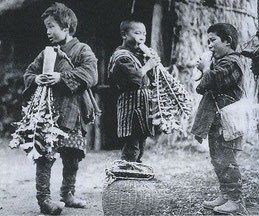
There is a famous photo of a poor child munching on a mana radish, but it was actually an extremely nutritious snack.
However, because the absolute amount was small, people may have been lacking in calories. However, since no one had a big belly in the past, it seems that being obese was much healthier than being fat.
There's a funny story about school lunches.
Apparently, a kindergarten in Kyushu serves brown rice for lunch as part of its nutritional education program. Because the rice is hard, children naturally chew it well. Having a strong jaw also improves the brain's ability to function.
The school lunches are rich in vitamins and are luxurious in a sense.
"My child really doesn't catch colds anymore."
Apparently, mothers in their late 20s to early 30s were also surprised. Their faces looked serious during the interviews, so I don't think it was staged.
Even if the cost of school lunches goes up, medical expenses are saved. It's a question of which is better for the child.
There may be many children who feel more energetic and mentally stable when they eat brown rice.
Incidentally, just as a person's personality is determined by the age of three, it is said that the foundations of the human tongue are also formed during infancy. The taste-sensing organs on the tongue, the bumps (mirai), reach their peak of growth at age 12. Therefore, the tastes that a child learns in elementary school are the peak of their taste, moms!
I strongly believe that the foods a child who grows up eating healthy, well-cooked brown rice/rice with lumps of rice will likely eat in the future are completely different from those a child who grows up eating cheap, imported white rice.
A society with a disparity in food. Well, there are people like me who are "picky about rice," but I think that man had a very rich diet when he was a child.
Therefore, as a fellow Japanese, I cannot help but hope that children will grow up eating not only delicious food, but also Japanese food made by their mothers using Japanese rice (preferably our company's rice!) that is cooked with love, and not just spicy hawker food, imported rice, McDonald's, or junk food.