Home

From rice planting to harvesting and brown rice production

The Four Seasons of Premium Koshihikari Rice - From Hakusan City, Ishikawa Prefecture

With the cooperation of producer Rokusei Co., Ltd. (Matsuto, Hakusan City, Ishikawa Prefecture), we hope to share with you the production scene of the premium Koshihikari rice (grown without pesticides or chemical fertilizers) that we carry, along with the rich Japanese four seasons.

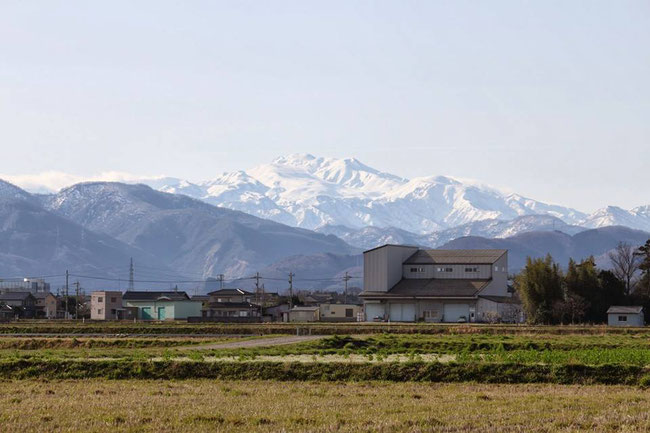
Hakusan, one of Japan's three most famous mountains, can be seen from the rice paddies. The magnificent nature nurtures premium rice.

Prologue: Cherry Blossom Time

Before planting rice, the rice seeds are germinated and the seedlings are grown so that they can be planted.

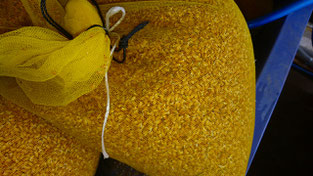
The seeds are soaked in lukewarm water at 32°C for 24 hours and circulated to promote germination (germination machine).

The rice seeds are sown in a seedbed. After a while, cute green seedlings will begin to grow.

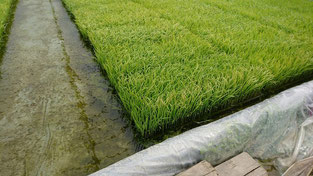
The photo shows water. Premium rice, which is grown without chemical fertilizers, does not grow vigorously, so water is used to stabilize it so that it can withstand the extreme temperature changes in early spring.

It's hard to see, but there are lots of germinated seeds inside.

Organic fertilizers of plant and animal origin are mixed into the seedbed to promote growth.

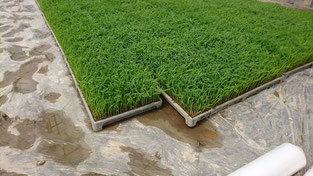
Regular rice grown using chemical fertilizers is left to grow in a greenhouse. It's easy to just leave it there and not have to do anything.

The yellow-green seedlings are premium rice. The dark green seedlings are regular rice grown with nitrogenous chemical fertilizer. Even at this stage, it seems like growing rice without pesticides or chemical fertilizers is going to be a lot of work.

Chapter 2: When I was a young leaf

Premium rice, which is grown without pesticides or chemical fertilizers, is delicate. It takes many times more effort to cultivate than rice grown using regular pesticides and chemical fertilizers. Let's take a look at the rice planting scene in mid-May.

Premium rice is grown using only organic fertilizer, so it grows slowly. This means that nutrients in the soil are easily stolen by fast-growing weeds, and because it is grown without pesticides, these weeds are difficult to eradicate. So...

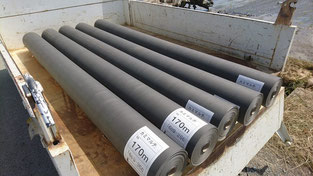
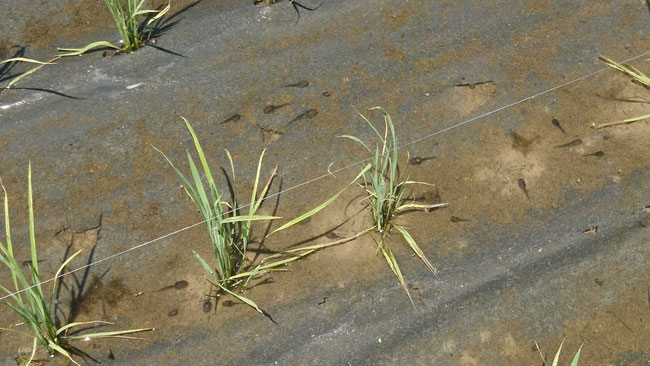
The paper mulch containing activated carbon is a great solution. It is laid on top of the rice paddy and seedlings are allowed to pop out through the gaps, preventing sunlight from reaching the weeds.

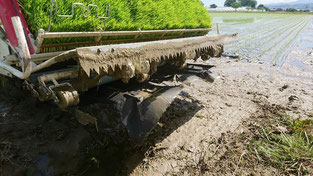
It's hard to see in the photo, but the technique involves attaching a paper mulch roller to the rice transplanter, and as the seedlings are planted, paper mulch is laid underneath them.

The paper mulch dissolves in the rice paddy over 45-60 days. It contains activated carbon, which acts as a soil conditioner by adding alkalinity to the soil. The charcoal also allows air to mix into the soil, making it easier for microorganisms to live.

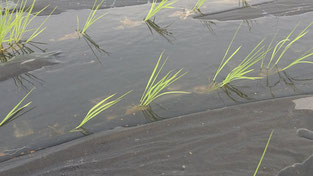
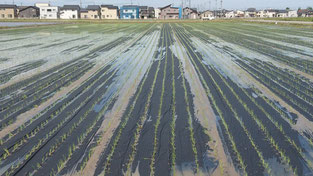
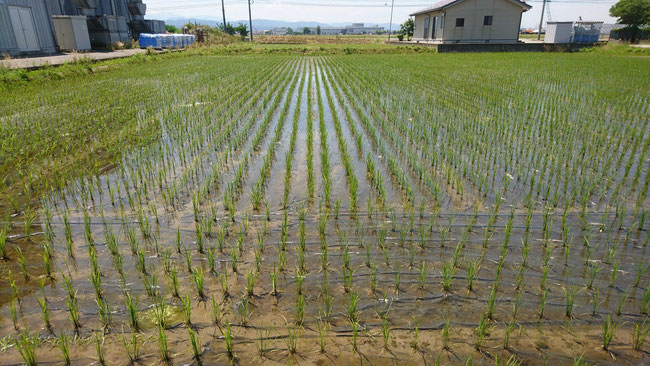
If you can't see the paddy field directly, it's hard to tell it apart from a field, but you can see tiny seedlings peeking out from the paper mulch covering the area. This allows the rice plants to grow without losing their nutrients to weeds.

Chapter 3: The Time of Fresh Greenery

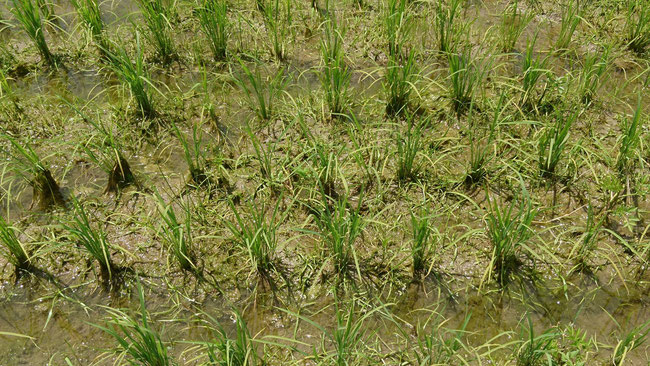
The state after about a month. Thanks to the shading effect of the paper mulch, there are no weeds even without herbicides.
In rice paddies that do not use paper mulch, weeds suddenly appear. If no pesticides are used, these weeds must be removed manually.
There are lots of tadpoles. The pesticide-free rice paddies with paper mulch are a paradise for microorganisms such as water fleas and pond snails.

Chapter 4: When the Frogs Croak

The paper mulch containing activated carbon has become one with the soil. Summer is the season for weeds to grow. If left unattended, these long weeds will grow thick.

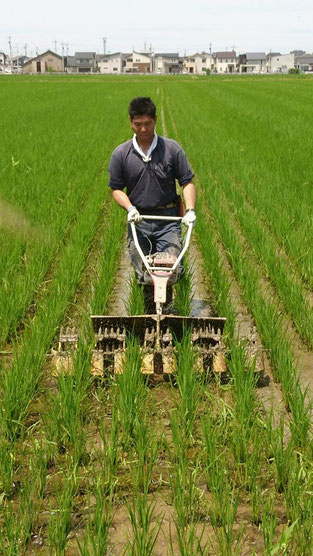
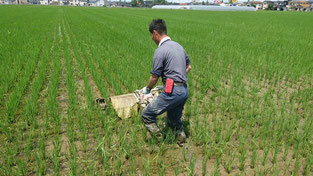
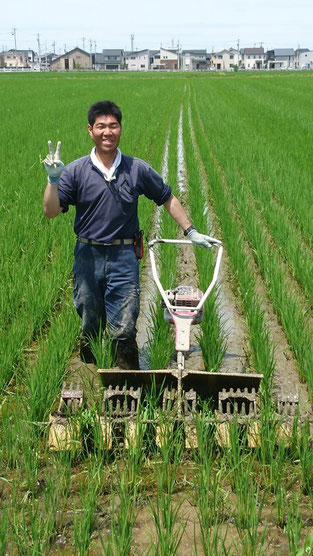
That's where this weed-killing machine comes in handy. It's commonly known as "Momotaro" (named by rice growers). It uses five rollers to push the weeds growing between the rice plants into the paddy field. This is easier work than pulling them out one by one.

Normally, weeds can be easily eradicated with herbicides, but in this scene, people are forcing the weeds into the soil by hand. This clearly shows how difficult it is to produce pesticide-free rice.

The paddy fields are not soil but mud, so your feet get muddy and it's hard to move forward. In the paddy fields where frogs are croaking, it's a test of physical strength and guts.

Senpai, I love you, love.

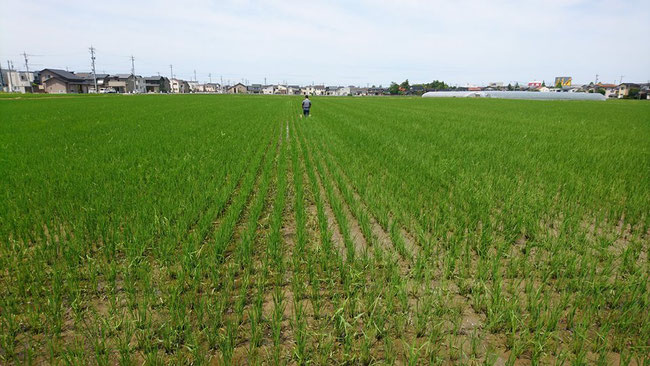
A small young man can be seen in the distance. The temperature on this day, just after the rainy season, is 32°C. The young man makes his way through the mud with Momotaro, a weed-killing machine. In their wake, not even a single weed grows.

Chapter 5: When the Cicadas Sing

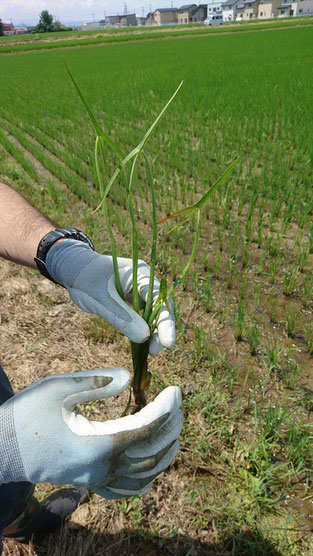
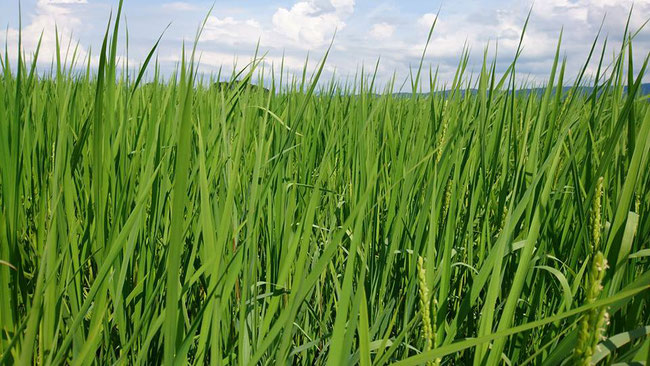
It's early August. Last month, the premium rice plants were still small elementary school students, and were in danger of being overwhelmed by the weeds that kept coming up. But now, under the blazing sun, they have grown exponentially and are now about the size of high school students.

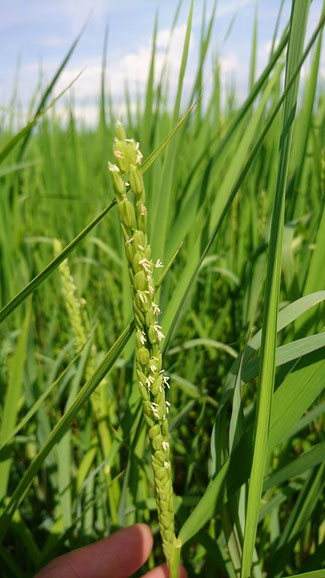
If you look closely, you can see that the ears are beginning to appear.

Small white dots peek out from the lush green ears of rice. These are rice flowers.

The flowers bloom early in the morning, and the pistils are pollinated by wind-blown pollen. The flowers finish their short life before noon.

Finally, the starch that will become rice begins to accumulate within the rice ears.

One of these ears of rice will be exported all the way to Singapore.

Golden Akitakomachi rice - Harvest

The harvest season in Akita Prefecture runs from mid-September to mid-October. This period coincides with the time when typhoons hit, and many rice plants are blown over by the wind.

Depending on the hardness of the soil, the root system, the thickness of the stems, the length, and the state of the rice crop, if conditions are bad, rice paddies can be completely destroyed, even though they are just about to be harvested.

This rice paddy is not toppled anywhere, and the harvest is artistic. This must be Akita Komachi grown by a top-class farmer. I have the impression that rice produced with the skill and pride of a professional farmer is more delicious than rice produced by an amateur part-time farmer.

By the way, Iwate Prefecture is on the other side of the mountain.

This is what it looks like up close.

This year has been a year of typhoons, heavy rains, sudden downpours and flooding across the country. However, Akita Prefecture has had a generally mild climate except in the northern part of the prefecture and around Lake Tazawa, so the crop yield is said to be normal.

If this is average, does that mean that in a bumper harvest year, the ears will be even more densely packed? By the way, in some areas, more than 600 kg of brown rice is harvested per 10 ares (10 m2). The national average seems to be around 540 kg.


Long ago, Akita beauties worked hard in the fields wearing colorfully colored and patterned work clothes called "kasuri," as shown in the photo above. Kasuri was made by housewives as a side job during the winter farming off-season.

Nowadays, it is only worn at events as an Akita obako (beautiful Akita woman's daughter) cosplay. It is an elaborate piece of weaving colored threads together, and if you were to buy it now, it would cost a fair amount of money.

The female divers in the TV drama "Amachan" also wore kasuri haori coats while catching sea urchins. It seems that this was a modest fashion for women working in agriculture, forestry, and fisheries in the past.
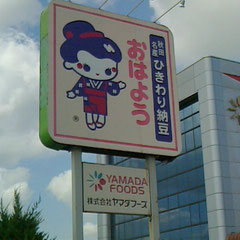
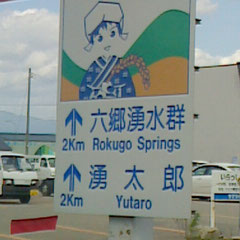
Akita beauties wearing kasuri have also been adopted as local image characters.

On the left is the character for "Good Morning Natto," sold by Yamada Foods in the southern part of the prefecture. On the right is the character on the signboard that announces that you have entered the nearby town of Misato. In addition, Akita Obako wearing kasuri patterns are also used on the packaging of Akita Komachi natto sold by various production areas.

It seems that the Ono no Komachi-style image character has now fulfilled its role.

The harvested rice is then turned into brown rice by farmers using equipment like the one shown on the right.

① Dryer → ② Thresher → ③ Stone removal machine → ④ Millet sorter → ⑤ Color sorter → ⑥ Bagging

After going through this process, the rice is turned into brown rice.

Dryer ① exposes the rice to hot air for about eight hours to reduce the moisture content to 15% or less. If the rice is too dry, it will crack, and if it is over 15%, it will not be ranked as "first-grade rice" and may even cause a deterioration in quality.

②The rice is turned into brown rice using a thresher.

Steps 3 and 4 appear to be carried out simultaneously, but brown rice that is 1.9 mm or larger is classified as "small rice," and brown rice that has been eaten by stink bugs and turned black is filtered out using a color sorting machine.

For better or worse, Japanese rice is a standard product. Just like vegetables, it costs money to produce it to a level that can be sold in stores. This is why Japanese rice looks great and boasts a high-quality taste that is on a global scale.

Without steps ③ and ④, there would be a great deal of variation in quality, and Japanese rice would no longer be highly regarded around the world.

The rejected rice (rice that does not meet the standards) is graded as second or third grade and used for processed foods such as miso and rice crackers.
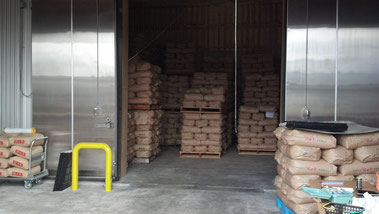
The bagged brown rice is collected at a collection point with a constant temperature and humidity warehouse.

Under conditions of humidity below 70% and temperatures between 15 and 18 degrees, the deterioration rate of brown rice slows down significantly, and it will remain delicious to eat even next year. However, old rice will dry out and lose moisture, resulting in a dry, stale rice.

By the way, the rice purchased by the government as stockpiles is stored in an environment below 15 degrees for 7 or 8 years. It is still edible, but it is not at a level that is needed in the Japanese household market.

It is released to the market through bidding several times a year. It is probably blended with slightly better quality rice and then distributed to consumers through school lunches, public office cafeterias, etc. (?)

In any case, Inazou Rice Store uses reefer (refrigerated) containers to maintain the storage conditions of the constant temperature and humidity warehouses at the production site, and rents a constant temperature and humidity warehouse in Singapore, so that we can deliver rice directly from the production site to you in the best condition.