


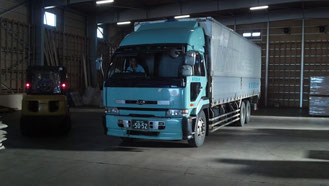
We are preparing to depart from Akita Port. We have arrived at the bonded warehouse where the loading work will be carried out.
Akita Komachi and Hitomebore brown rice, collected from various parts of Akita and Iwate prefectures, has arrived.
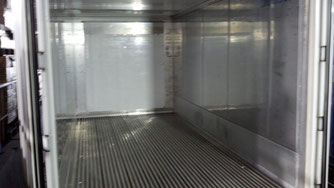
This is the inside of a reefer container. Unlike dry containers, this is our chartered container. The cost is quite high, but we don't want to export Akita Komachi, which is said to be the most delicious in the world, to the point where it becomes indistinguishable from rice from Vietnam, Australia, the United States, etc., even though we love it so much.
I want Akita beauties to remain Akita beauties when they get married .
Isn't that what a true parent feels? Fathers, Akitakomachi should remain Akitakomachi and be loved by the people of Singapore.

There is an adjustment device on the front. I think the setting is between -25°C and +25°C. For rice, it seems that a temperature of around 15°C to 19°C, which is roughly room temperature, is ideal.
However, 15°C is the temperature at which the Japanese government stores its stockpiles of rice for years.Below 15°C, brown rice goes into hibernation and barely breathes, which causes the deterioration rate to slow down dramatically.
Since the rice will not be stored for years, and therefore does not need to be kept at such a high temperature, we decided to export it at a temperature that matches the conditions of Singapore's constant temperature warehouses. A sudden change in the environment could damage the quality of the rice.
By the way, near the equator, the temperature inside a dry container can reach 70°C. The ceiling can get so hot you can fry an egg inside. It's like a sauna, and if food were to be exported from Japan to Singapore in a dry container, it would be impossible to maintain Japanese quality.
Although the shipping costs are somewhat higher for sake, rice, other food products, precision machinery, etc., reefer containers are essential for exporting Japanese quality goods. Otherwise, the shipping costs would be six times higher and goods would have to be shipped by air within a day.
Therefore, when eating imported food in Southeast Asia or other tropical countries, knowing how it was transported is an important point in understanding the quality of the food.
The same is true when consuming foreign products in Japan, and whether or not the wine is imported in a reefer container seems to be the biggest factor in determining whether or not it maintains the French flavor.
Alcohol has a shelf life of over 100 years. In the case of French wine, if the same wine tastes completely different in France and Japan, you should suspect that there was a serious problem in the export process.
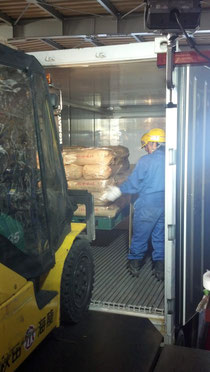
In any case, it appears that this is the first time in history that 30kg bags of brown rice have been exported from Akita Port.
Until now, when Akita Komachi rice was exported overseas, it was milled in Akita, packaged, and transported to Singapore over a three-week period, taking nearly a month for it to appear on store shelves.
The best-before date for rice is one month after it is milled (the period during which it can be eaten deliciously), so it would be impossible for people to enjoy the taste of Japanese rice, which is considered to be the best in the world, especially Akita Komachi rice, which I have loved since I was a child.
What's more, if it costs more than twice the price in Akita, no one will buy it even if they want it. The "global spread of Japanese agricultural products" will be nothing more than a pipe dream.
In Japan, Akitakomachi rice is a national favorite along with Koshihikari rice, but in Singapore, if it is considered rice for the wealthy, wouldn't our beloved Akitakomachi rice not be loved by everyone?
Furthermore, if the polished rice is exported in dry containers, it will be transformed into a completely different product in Singapore, and it should not be branded as "Akita Komachi rice from Akita Prefecture."
That is why the process of exporting the rice in reefer containers and milling it locally is essential to allow people to experience the true quality of Akita Komachi and Hitomebore rice.
Although Akitakomachi and Hitomebore are cheaper than Koshihikari, they are not inferior in taste. When it comes to Special A grade rice, it becomes a matter of personal preference, with people preferring sweeter rice or less sticky rice.
Therefore, I strongly believe that the rice varieties with the greatest global potential are not Hokkaido's Yumepirika or Nanatsuboshi, which are emerging as new rice varieties, or the traditional Niigata Koshihikari, but Akita Prefecture's Akita Komachi and Iwate Prefecture's Hitomebore, which has been ranked Special A for 18 consecutive years.
---
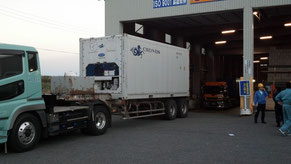
Reefer containers filled with brown rice are moving out from a bonded warehouse near the port.
Akita Port is 3 kilometers from here.
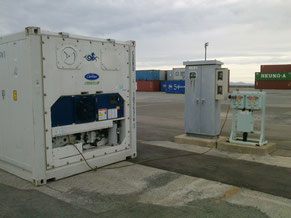
A container waiting to be loaded after customs clearance at the port. After customs clearance, the cargo changes from domestic cargo to foreign cargo. Reefer containers do not have batteries, so they must be connected to a power source at all times, as shown in the photo.
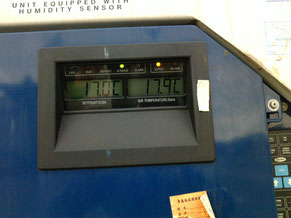
As you can see, the temperature is set to around 18 degrees.
At this time, the temperature in Akita was around 18 degrees, the temperature inside the container was also around 18 degrees, and the temperature in the warehouse in Singapore was also around the same, so a constant, cool temperature was maintained throughout.
All that remains is to pray that the reefer container doesn't break down on board. If it does, the temperature inside the container will quickly rise to the same sauna-like temperature of nearly 70°C as in a dry container, and my beloved Akita Komachi rice will be boiled and transformed into a completely different type of rice.
I hope she arrives in Singapore still an Akita beauty!
The time had finally come for Akita Komachi to set off on her journey.
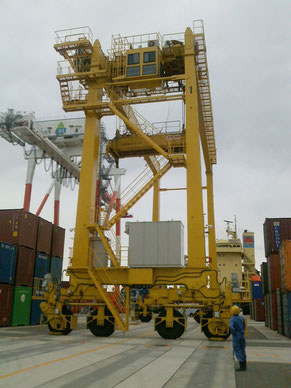
This 30-meter-tall crane carries cargo to the designated location where it will be loaded onto the ship by the even larger gantry crane in the back. The person on the bottom right is a person, but if you look closely, you'll feel like you're looking at a brontosaurus or some other creature.
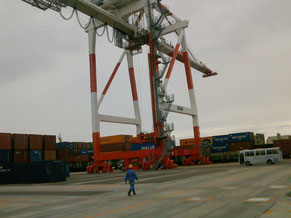
This is a gantry crane that loads containers onto a ship. In the background, you can see a container ship being unloaded. It is heading to Singapore via Busan.
The lower part is a person, but the yellow one looks like a child, about twice as tall. There is only one in Akita, but I believe there are six in Sendai Port, and more than twice as many in Tokyo and Yokohama.
The scale is said to be even larger in Busan, Hong Kong, and Singapore, which boast some of the world's largest container handling volumes.
In this way, the Akita Komachi brown rice takes about two weeks to travel to Singapore (it takes about one week in total to meet up in Busan and go through customs in Singapore).
Akita Komachi sails across the open sea.