







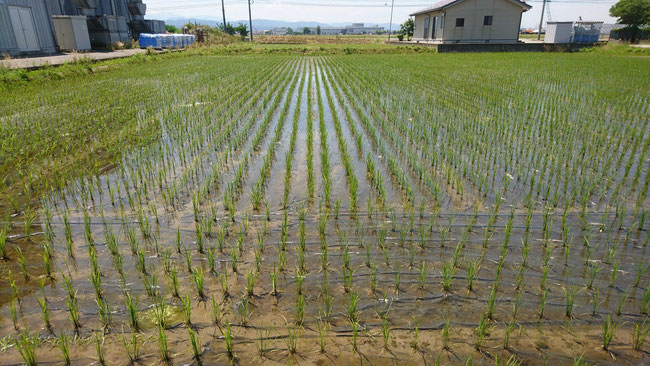

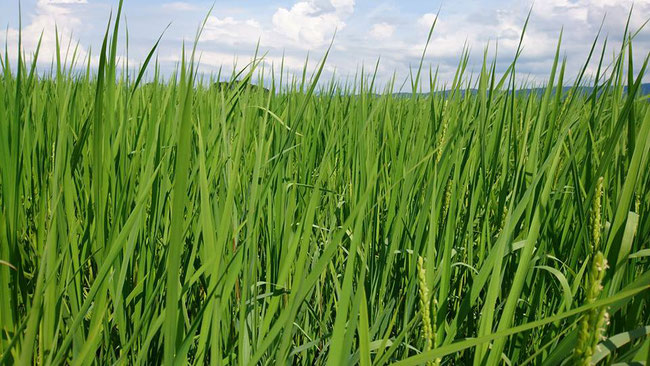

The harvest season in Akita Prefecture runs from mid-September to mid-October. This period coincides with the time when typhoons hit, and many rice plants are blown over by the wind.
Depending on the hardness of the soil, the root system, the thickness of the stems, the length, and the state of the rice crop, if conditions are bad, rice paddies can be completely destroyed, even though they are just about to be harvested.
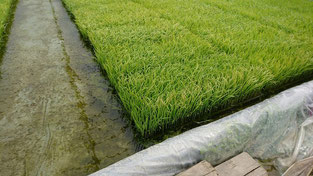
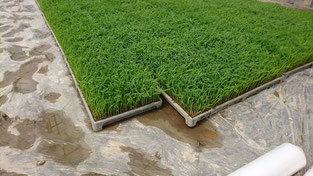
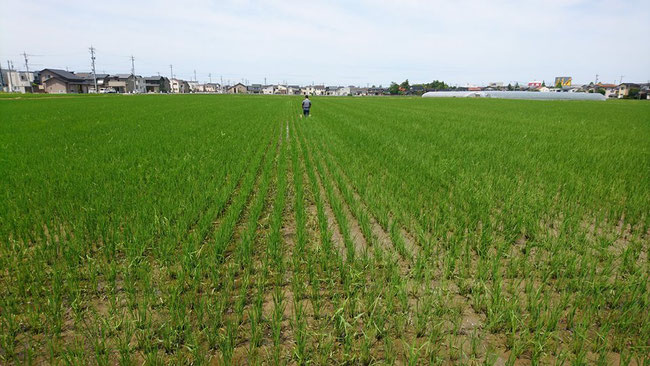
This rice paddy is not toppled anywhere, and the harvest is artistic. This must be Akita Komachi grown by a top-class farmer. I have the impression that rice produced with the skill and pride of a professional farmer is more delicious than rice produced by an amateur part-time farmer.
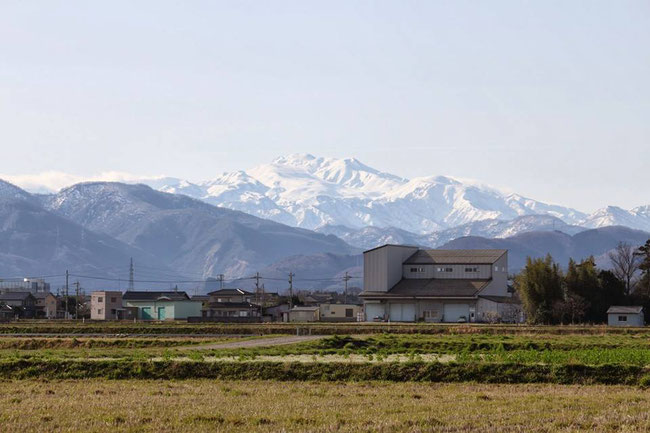
By the way, Iwate Prefecture is on the other side of the mountain.

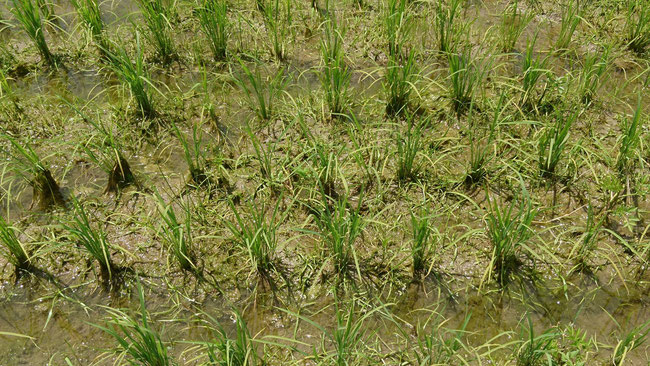
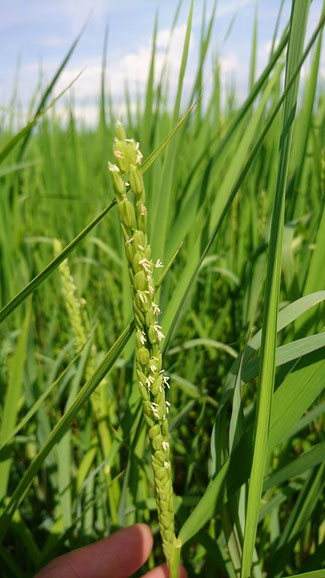
This is what it looks like up close.
This year has been a year of typhoons, heavy rains, sudden downpours and flooding across the country. However, Akita Prefecture has had a generally mild climate except in the northern part of the prefecture and around Lake Tazawa, so the crop yield is said to be normal.
If this is average, does that mean that in a bumper harvest year, the ears will be even more densely packed? By the way, in some areas, more than 600 kg of brown rice is harvested per 10 ares (10 m2). The national average seems to be around 540 kg.


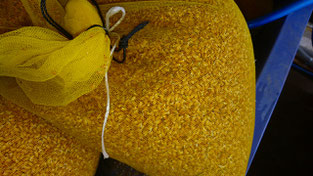
Long ago, Akita beauties worked hard in the fields wearing colorfully colored and patterned work clothes called "kasuri," as shown in the photo above. Kasuri was made by housewives as a side job during the winter farming off-season.
Nowadays, it is only worn at events as an Akita obako (beautiful Akita woman's daughter) cosplay. It is an elaborate piece of weaving colored threads together, and if you were to buy it now, it would cost a fair amount of money.
The female divers in the TV drama "Amachan" also wore kasuri haori coats while catching sea urchins. It seems that this was a modest fashion for women working in agriculture, forestry, and fisheries in the past.
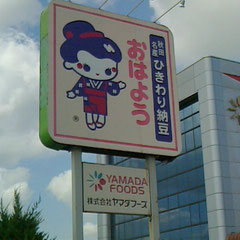
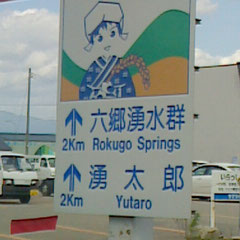
Akita beauties wearing kasuri have also been adopted as local image characters.
On the left is the character for "Good Morning Natto," sold by Yamada Foods in the southern part of the prefecture. On the right is the character on the signboard that announces that you have entered the nearby town of Misato. In addition, Akita Obako wearing kasuri patterns are also used on the packaging of Akita Komachi natto sold by various production areas.
It seems that the Ono no Komachi-style image character has now fulfilled its role.

The harvested rice is then turned into brown rice by farmers using equipment like the one shown on the right.
① Dryer → ② Thresher → ③ Stone removal machine → ④ Millet sorter → ⑤ Color sorter → ⑥ Bagging
After going through this process, the rice is turned into brown rice.
Dryer ① exposes the rice to hot air for about eight hours to reduce the moisture content to 15% or less. If the rice is too dry, it will crack, and if it is over 15%, it will not be ranked as "first-grade rice" and may even cause a deterioration in quality.
②The rice is turned into brown rice using a thresher.
Steps 3 and 4 appear to be carried out simultaneously, but brown rice that is 1.9 mm or larger is classified as "small rice," and brown rice that has been eaten by stink bugs and turned black is filtered out using a color sorting machine.
For better or worse, Japanese rice is a standard product. Just like vegetables, it costs money to produce it to a level that can be sold in stores. This is why Japanese rice looks great and boasts a high-quality taste that is on a global scale.
Without steps ③ and ④, there would be a great deal of variation in quality, and Japanese rice would no longer be highly regarded around the world.
The rejected rice (rice that does not meet the standards) is graded as second or third grade and used for processed foods such as miso and rice crackers.
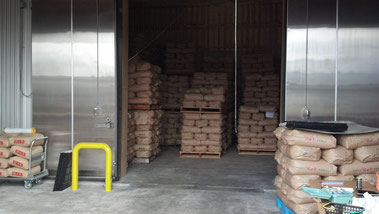
The bagged brown rice is collected at a collection point with a constant temperature and humidity warehouse.
Under conditions of humidity below 70% and temperatures between 15 and 18 degrees, the deterioration rate of brown rice slows down significantly, and it will remain delicious to eat even next year. However, old rice will dry out and lose moisture, resulting in a dry, stale rice.
By the way, the rice purchased by the government as stockpiles is stored in an environment below 15 degrees for 7 or 8 years. It is still edible, but it is not at a level that is needed in the Japanese household market.
It is released to the market through bidding several times a year. It is probably blended with slightly better quality rice and then distributed to consumers through school lunches, public office cafeterias, etc. (?)
In any case, Inazou Rice Store uses reefer (refrigerated) containers to maintain the storage conditions of the constant temperature and humidity warehouses at the production site, and rents a constant temperature and humidity warehouse in Singapore, so that we can deliver rice directly from the production site to you in the best condition.