


Mount Kurikoma, Akita Prefecture
It is said that the sweetness of rice is determined by the temperature difference between day and night. At night, when the temperature drops, the fruit breathes more deeply. It means that sweetness is added to the rice by sucking up the sugar that becomes energy from the roots.
Ladies and gentlemen, do you know the exact location of Akita prefecture? ?
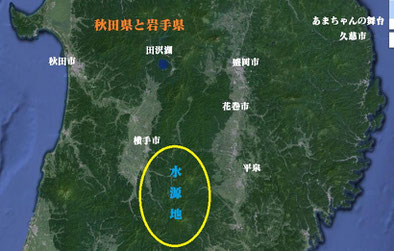
It is on the northern edge of Honshu, just south of Hokkaido. Which is west of Tokyo, Shimane or Tottori? It may be the same feeling as Ehime and Tokushima, which is from Osaka is a bit of a conundrum.
The sadness of depopulated prefectures. The positional relationship between Tochigi and Gunma is also subtle. Well, more than that, the deliciousness of Akitakomachi is produced in Akita prefecture, which should be proud of to the world.
The Ou Mountains separate Akita and Iwate. The northernmost part on the Aomori Prefecture side is famous for Mt. Hakkoda, and the southern part on the Fukushima Prefecture side extends to Lake Inawashiro where Hideyo Noguchi was born. The Ou Mountains are a large mountain range that can be called the bones of Japan's neck.
The Akita Komachi rice produced in Hiraka and Jumonji, Akita Prefecture, which is sold by Inazo rice stores, is sourced from Mt. Kurikoma, the king of the Ou Mountains.
The clear stream of the Naruse River connects Yokote City in Akita Prefecture with the water source. The abundance of nature once gave birth to two manga artists called "masters". 
The picture on the right is a billboard in Higashinaruse village, but Mr. Yoshihiro Takahashi of "Ginga ~Nagareboshi Gin~". The photo on the left is Mr. Takao Yaguchi, who is from Masuda-cho, Yokote City, and is a fisherman of Sanpei.
Both manga are set in Akita Prefecture, really around this water source. A primitive mountain forest spreads out, where a hermit really seems to appear.
There are many Asian black bears around here, and in the past, matagi carrying guns made their living by hunting bears. A hunting dog called "Kuma-inu" helped them. The protagonists of the Ginga series are members of that bear dog clan.
"Tsurikichi Sanpei" is almost a character that symbolizes Akita Prefecture. In Akita City, there is even a flashy bus painted with Sanpei called the "Sanpei Bus".
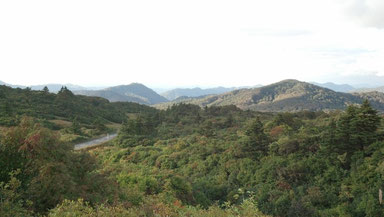
Observation near the summit of Mt. Kurikoma Looking at the photo, it looks like a great nature that can be found anywhere in Japan, but...
There is a hot spring near the summit, which is the border between Akita and Iwate prefectures. It seems that many people visit every day after climbing nearly 1000 meters. There are lodging facilities, so it will be crowded during the autumn leaves season.

A small stream called "headstream" like the one on the far right gathers to form an "upstream" like the one on the left. It is a clear stream that seems to be fishing for char and yamame trout, but in fact, many anglers swing their rods and catch fish with artificial bait.
A sign next to a spring called "Sennin-sui". 
According to the water quality survey... Anyway, you can see that all the values are well below the standard value.
Chromaticity of 5 degrees or less is normal, but chromaticity of less than 05 degrees means that it is considerably beautiful. I would like to see an analysis of the mineral values, but I feel that it is not inferior to the natural water of the Southern Alps.
When you drink it... it's cold and delicious! I have no choice but to describe it as a feeling of joy as my digestive system is moistened by this holy water.
If you go down the river, you will find rice fields that use the river as a source of water. 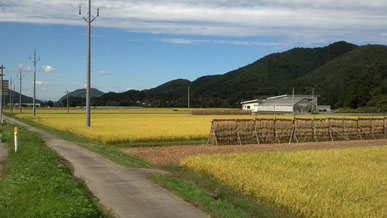
The photo shows the scenery of naturally drying fir trees. If everything goes well, it will dry in about two weeks, and you will have delicious rice that smells like the sun. However, if it rains, it will fail to dry and the rice will be difficult to store.
In the case of farmers, it seems that the rice they eat is dried in the sun, and the rice they sell is dried in a dryer. 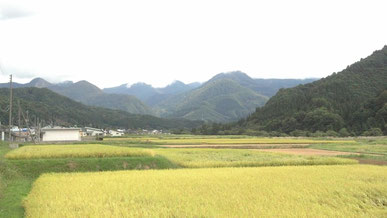 The water source is on the other side of that mountain. Over there, the nameless Akachan River becomes the Naruse River, gathers its tributaries and becomes the adult Naruse River, and eventually joins the Omono River, which runs through Akita Prefecture. It looks like a success fish.
By the way, because of the extreme temperature difference in this area, fruit cultivation is also very popular. 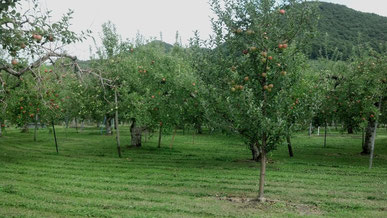 Specialty products are apples, grapes and rice. Summer is hot and winter is cold. In a heavy snowfall area, there is a large difference in temperature between day and night. The climate is very similar to that of Yamagata Prefecture in the south.
It is said that the sweetness of rice is determined by the temperature difference between day and night. At night, when the temperature drops, the fruit breathes more deeply. It means that sweetness is added to the rice by sucking up the sugar that becomes energy from the roots.
The Uonuma region in Niigata Prefecture, which is called the best in Japan, is also a mountainous area with heavy snowfall.
Hanamaki City and Hiraizumi Town in Iwate Prefecture, which straddles the Ou Mountains, are also long basins formed between mountains centered on the Kitakami River. water, soil, and climatic conditions,
"Conditions for producing delicious rice"
That's what it means.
Therefore, even if the variety is the same, it is said that the taste differs depending on the production area.
Akitakomachi produced in Australia, Vietnam, or the United States has a completely different value than Akitakomachi produced in the clear waters where yamame trout swim in and where there is a large temperature difference between day and night.
Akitakomachi is Akitakomachi because it is made in Akita.