


Kitakami Golden Legend Hitomebore production area Iwate Hiraizumi Hanamaki
Iwate Prefecture became a prefecture of time with "Ama-chan". 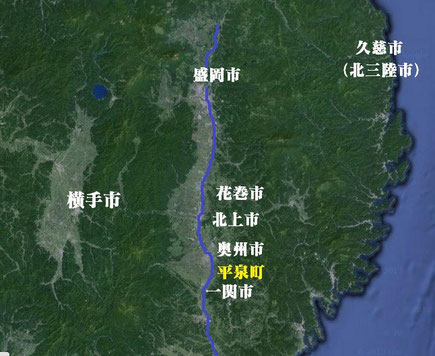
Anyway, it is huge, it is wider than Gifu and Nagano, and it boasts the second largest area in Japan after Hokkaido. Big things are good anyway.
Kitakami City is reached by crossing the Ou Mountains from Yokote City in Akita Prefecture.
Hanamaki City to the north, Oshu City to the south, Hiraizumi Town to the south, and the large breadbasket of the former Date domain. Also a district.
Many ruins from the Jomon period have been excavated from the Kitakami River basin.
Because it is a huge basin formed between mountains with a river at its center, it looks like a heavy snowfall area with hot summers and cold winters. However, thanks to the Kitakami River, which originates in the north of Morioka City, the soil is very rich, and the difference in temperature derived from the basin climate makes it one of Japan's leading breadbaskets of delicious rice.
Although it straddles the prefectures of Iwate and Miyagi, the scale of the countryside is comparable to that of Niigata Prefecture, Japan's number one rice-producing prefecture.
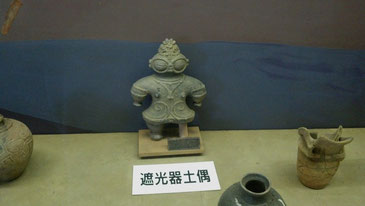
A familiar clay figurine excavated from the basin. This enshrined deity with big eyes and delicate style was also excavated from Akita Prefecture, so I have no idea what it means. Enshrined deities with similar appearances have been excavated from various places, so did aliens who could fly in the sky ruled Japan in the Jomon period?
I mean, it doesn't look like young ladies with big sunglasses that are about 1/3 of their face, which is popular these days. 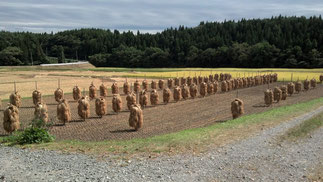
By the way, Iwate Prefecture seems to have a large percentage of rice that is dried in the sun. In contrast to Akita, such a scene spread out. 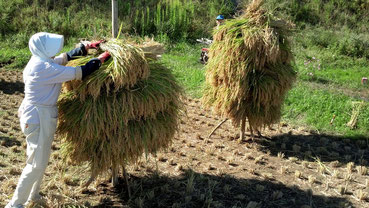
It's just a simple task of bundling some rice and hooking it on a stick, but it looks like a person in a period drama wearing a raincoat.
By the way, Hitomebore grown in southern Iwate Prefecture has been designated as a special A grade production area for 18 consecutive years by the Japan Grain Inspection Association. In other words, it is a production area that can stably provide delicious rice without being influenced by climate change.
From this point, you can see how easy it is to grow the Hitomebore variety. Hitomebore in the northern part of Miyagi Prefecture has also been designated as a special A grade production area, so the area from the southern part of Iwate Prefecture to the northern part of Miyagi Prefecture, that is, the area where the Kitakami River flows, the territory of the former Date Domain, was a gift of the Kitakami River. 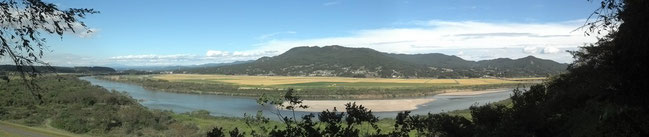
This scenery was taken from a small hill called Takadate in Hiraizumi-cho, where Minamoto no Yoshitsune, who was protected by Benkei, is said to have died.
In addition, Basho Matsuo, looking at this scenery,
Summer grass and soldiers are traces of dreams
It is also a famous scenic spot in the history of literature, where he wrote a haiku poem.
Where the Kitakami River meanders, a very fertile breadbasket spreads out between the mountains and the river.
During the Heian period, gold was mined from this area, which led to the construction of the Golden Hall of Chusonji Temple, which is registered as a World Heritage Site. It is said that foreigners who saw the Konjikido spread rumors about it, which spread to Europe and became the origin of the word JAPAN as "Zipangu = land of gold".
Marco Polo, who lived in China for 17 years, popularized Zipangu in Europe. Later, I will record the famous Toho memoirs. That is the eve of the Age of Discovery. Columbus read that book and was inspired by the legendary Zipangu to cross the Atlantic Ocean, so the connection of history is interesting.
If the Konjikido hadn't been built, Japan would have had a different name, and Marco Polo wouldn't have written Touhou Observations, so history would have changed dramatically.
Inazo Rice Store delivers rice from the Kitakami River Basin, which has such a golden legend, to everyone in Singapore. 
From Hiraizumi-cho, we crossed the Ou Mountains and returned to Akita Prefecture. 
Sugawadake Secret Water Bunano-Megumi
There is. The water quality is about the same as on the Akita Prefecture side. It is alkaline with a pH of 7.5, and I don't know what kind of effect this area will have on rice.
In any case, the water is really beautiful in the rice-growing area centered on the Ou Mountains. Because it is a heavy snowfall area, the melted snow contains abundant nutrients in the soil, making it one of Japan's leading high-quality water sources. 
There are countless streams like the one in the photo on the right, which flow into the Kitakami River and are the source of Hitomebore production.
In Niigata and Toyama, rice seems to be better along the Alps than along the sea, where the snow is deeper. The closer to the water source, the less domestic wastewater will flow into it.
Because it is upstream, it never dries up, and the nutrient-rich, pure forest water is used to grow crops. Therefore, it is possible to produce much better rice in the mountainous area than in the plains of the lower reaches, even if the rice is the same "produced in XX prefecture".